You cannot directly select special weapons for your wingmen in ACE COMBAT 8: WINGS OF THEVE. You choose each wingman’s aircraft, and that aircraft determines the special weapons assigned to the wingman. Unlocking or buying only the weapon you want does not reliably change that assignment. Your practical solution is therefore to choose wingman aircraft by their predefined loadouts, distribute useful roles across Joker Flight, and authorize special-weapon use only when those weapons can contribute.
This restriction applies to wingmen, not to your own aircraft. Your personal special-weapon selection remains a separate system. Do not confuse the player’s ability to configure a sortie with control over the rest of the formation.
Compare the aircraft roster and roles and mission-led aircraft recommendations before assigning the flight; budget squadron purchases with the MRP guide.
Version scope — October 7, 2026: This page was edited from supplied research. No numbered game build or independent playtest is recorded for this guide. Check the current in-game descriptions and your platform before applying build-sensitive conditions.
The wingman selection rule
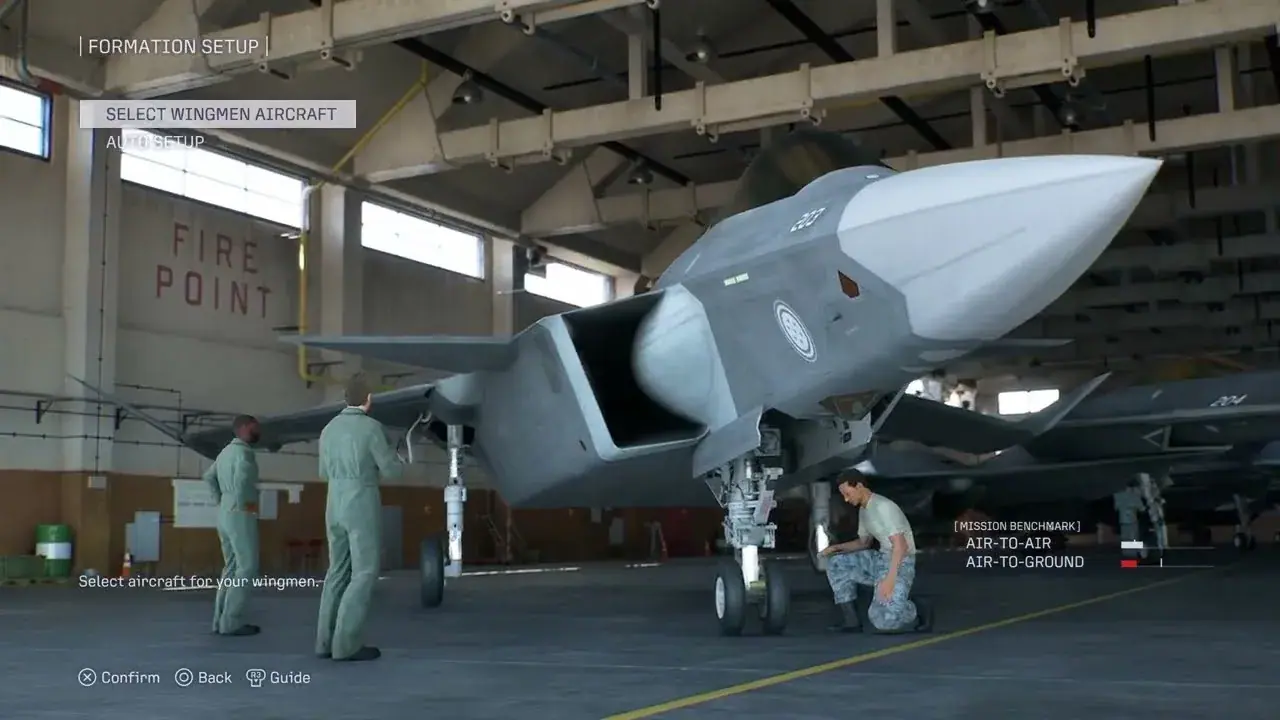
The formation setup screen shows that wingmen are assigned by aircraft package.
The formation screen gives you control over which aircraft each member of Joker Flight flies. It does not provide a separate special-weapon picker for those wingmen. Changing the pilot’s aircraft is the supported way to change the special weapons that pilot brings.
The resulting limitation is important: a versatile aircraft may not give a wingman the same role-focused combination you would choose for yourself. A plane that works as your pure air-to-air build can still give a wingman a mixture of air-to-air and air-to-ground weapons. The same problem can occur in reverse during a ground-heavy sortie.
Treat every wingman aircraft as a package rather than as an empty platform. That package includes the aircraft’s general role and its predefined wingman weapons. If one part of the package does not fit the mission, selecting a more specialized aircraft may be more useful than insisting on a matching formation.
Community testing also indicates that wingman assignments are not reliably controlled by which weapons you personally purchased. Players reported wingmen using predefined weapons even when those weapons had not been bought for the player. Buying weapons in a particular order, leaving part of the Aircraft Tree unfinished, or purchasing only one preferred option should not be treated as a dependable workaround.
Player special weapons and wingman weapons are different systems
Your aircraft can eventually carry either one or two different special weapons. When you select one special weapon, it occupies the available hardpoints. Selecting a second different weapon divides those hardpoints between the two choices and reduces the ammunition available for each. Selecting NO WEAPON in the second slot keeps the single-weapon setup. Selecting the same weapon twice is not an alternative way to increase its ammunition.
Wingmen do not follow that manual selection process. Their aircraft supplies a predefined special-weapon combination, and you cannot reduce that combination to one weapon for a larger ammunition pool. You also cannot copy your own loadout to the formation.
If your personal second slot is not available early in the campaign, continue progressing and check the sortie menu again later. The player reports disagree about the exact unlock point, so an aircraft level or a specific early mission should not be presented as a guaranteed condition. That uncertainty does not change the wingman rule: even after your own two-weapon configuration becomes available, wingman weapons remain tied to their aircraft.
How to choose the best wingman aircraft for a mission
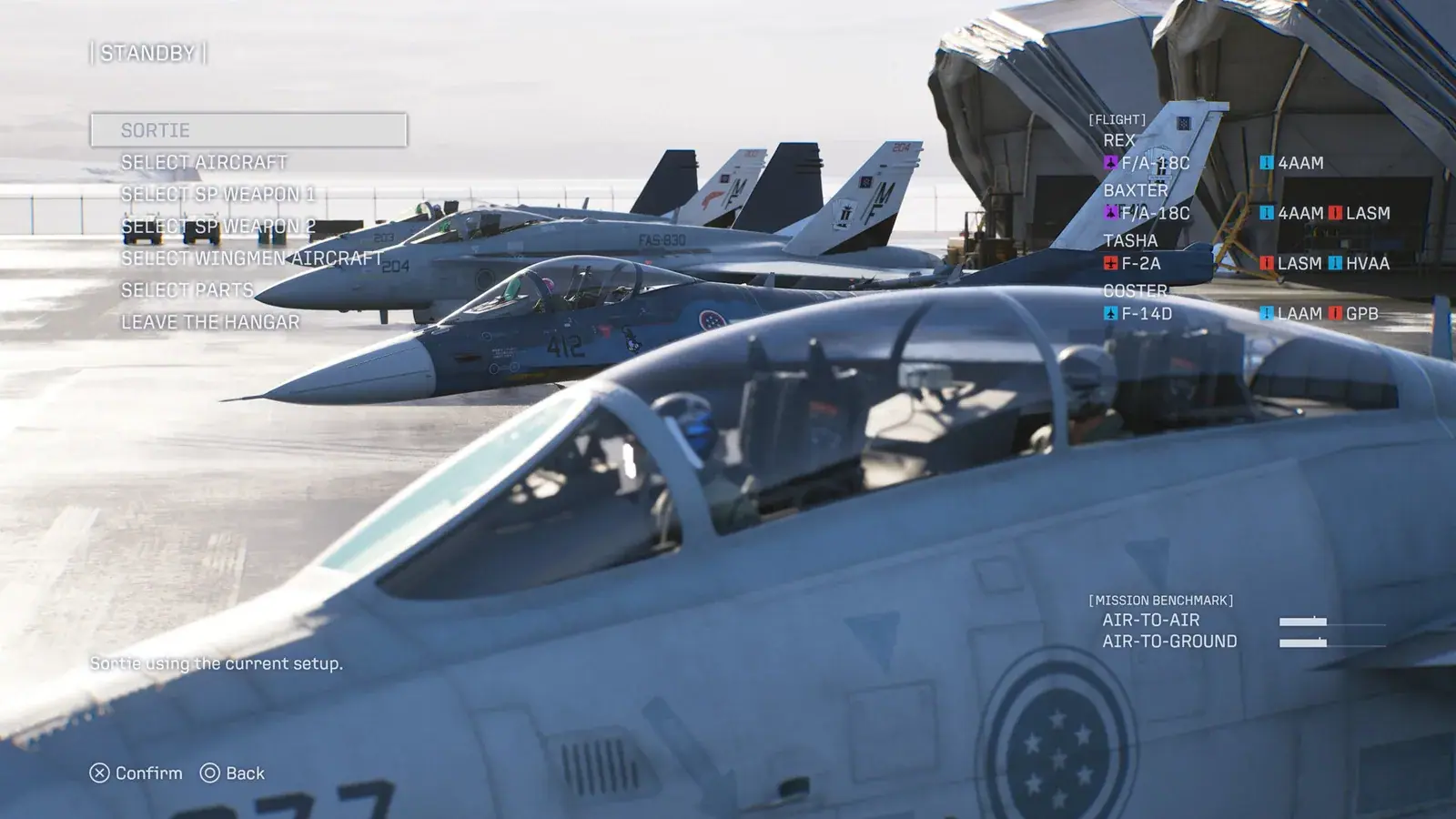
Mission benchmarks help identify whether a sortie favors air or surface targets.
Use the briefing and expected target mix before looking at aircraft names. The goal is not to build the most impressive formation; it is to ensure that the squad has weapons it can actually use during the important parts of the sortie.
- Classify the mission’s main job. Decide whether the briefing points toward an air-heavy, ground-heavy, naval, escort, or mixed operation. Treat this as a planning estimate rather than a promise that no other target type will appear.
- Configure your own aircraft first. You have the most control over Rex, so use your personal aircraft, special weapons, and parts to cover the mission’s hardest or most time-sensitive task.
- Evaluate wingman aircraft as fixed packages. Look for aircraft whose assigned wingman weapons support the target mix. Do not judge a candidate only by how you would configure it when flying it yourself.
- Cover the most important gap first. If you bring specialized anti-ground weapons, consider giving at least one wingman a stronger air-to-air role. If you are focused on fighters, give the formation a way to contribute against surface targets when the mission calls for it.
- Avoid three copies of the same mismatch. A matching formation looks coherent, but three wingmen carrying an unsuitable predefined option magnifies the limitation. Mixed aircraft can provide better coverage.
- Plan special-weapon authorization before launch. Identify the phase or target group that deserves limited SP ammunition. This prevents you from treating authorization as a command that should remain active from the opening engagement.
This method does not guarantee that wingmen will destroy a particular target or perform like a player using the same aircraft. It simply aligns their available tools with the mission more closely and reduces obviously wasted loadout slots.
Wingman roles by target mix
| Mission need | Wingman selection priority | Your responsibility |
|---|---|---|
| Air-heavy battle | Aircraft with predefined air-to-air capability that remains useful against the expected formation | Bring the weapons and handling you trust for priority aircraft; do not assume wingmen will finish every dangerous target |
| Ground-heavy operation | Aircraft whose assigned weapons can engage surface targets instead of carrying mostly irrelevant air options | Lead safe attack runs and handle objectives that require precise targeting or timing |
| Mixed battlefield | Different aircraft packages that divide air and surface coverage across the formation | Use your configurable loadout to cover the category the wingmen handle least reliably |
| Concentrated target phase | Aircraft with special weapons suited to groups or high-value threats | Save authorization for that phase instead of spending limited ammunition on routine enemies |
| Defensive or escort pressure | A formation able to protect you while another member provides mission-relevant support | Use Cover when under pressure and remain close enough for the formation’s help to matter |
Electronic-warfare aircraft can be a useful support option when their predefined wingman package includes ESM or ECM. Player reports describe ESM support as particularly helpful because a wingman can activate it after receiving special-weapon authorization. That is a practical tactic, not a guaranteed best choice for every mission. Support charges may be consumed quickly, and the formation’s position can affect how useful the support feels.
When to authorize wingman special weapons
Aircraft selection determines what wingmen bring; the special-weapons command determines when they are permitted to use it. These are separate decisions. A suitable aircraft can still waste its limited weapons if authorization is given too early or during a low-value engagement.
Players commonly report that wingmen use special weapons aggressively after authorization. Because the exact behavior can vary with the aircraft, target situation, and formation, do not promise a fixed firing rate. Use a conservative command routine instead:
- Begin ordinary engagements without treating SP authorization as the default state.
- Use Attack when one important threat deserves concentrated attention.
- Use Disperse when many independent targets make wider coverage more valuable.
- Use Cover when enemy aircraft are pressuring you and survival matters more than the current attack run.
- Authorize special weapons when the available targets match the wingmen’s assigned loadouts.
- Do not rely on authorization to repair a bad pre-sortie choice. A ground weapon still has little value in a phase containing only aircraft.
Good authorization windows include a dense group that matches a multi-target weapon, a major surface cluster during a ground attack, or a dangerous formation that must be reduced quickly. Routine enemies, long travel periods, and target types that do not match the fixed loadout are poor reasons to spend the formation’s limited SP ammunition.
If a wingman announces that special ammunition is depleted early, adjust the next attempt rather than assuming the aircraft is useless. Delay authorization, reserve it for a later phase, or replace that aircraft with a package whose weapons fit more of the mission.
What to do when the assigned weapons are wrong
There is no menu option that converts a wingman’s fixed combination into your preferred one. Use one or more of these compensations:
- Change the aircraft. This is the direct control the game gives you. Prefer a less glamorous aircraft with a relevant package over a stronger aircraft carrying the wrong tools.
- Cover the missing role yourself. Your configurable loadout is the most reliable place to solve a specific mission requirement.
- Split roles across Joker Flight. One wingman can emphasize air combat, another surface attack, and another support or flexible coverage.
- Save authorization for the useful half of a mixed package. A mismatched weapon does not make the entire aircraft worthless if its other assigned option is valuable later.
- Change commands as the battle changes. Attack, Disperse, Cover, and special-weapon authorization solve different problems. One command should not remain your automatic choice for the whole sortie.
- Replay with a revised formation. If an unexpected mission phase exposes a gap, use that information to change aircraft and timing on the next attempt. Do not turn one result into a universal ranking of every wingman plane.
Standard missiles and normal wingman combat still matter when special weapons do not match the immediate target. A formation is not automatically ineffective because one SP slot is poorly suited to a phase. The correct conclusion is narrower: that slot should not be the center of your plan.
Failed workarounds and common misunderstandings
Buying only the desired weapon: This is not reliable. Reported tests show that a wingman can receive a predefined weapon regardless of the player’s purchase state.
Avoiding a third weapon unlock: Reports conflict over which listed weapons different aircraft receive, and an early claim that an unfinished selection could force the desired result was later withdrawn after testing. Do not structure Aircraft Tree spending around that claim.
Matching your own aircraft and weapons: Giving a wingman the same aircraft does not copy your manual SP choices. Your loadout and the wingman package remain separate.
Equipping the same weapon twice: Your own second slot cannot duplicate the first to increase ammunition. Choose a different weapon or retain a single-weapon setup with NO WEAPON. Wingmen offer neither choice.
Leaving SP weapons authorized throughout the mission: This may cause wingmen to spend limited ammunition before the phase where it would help most. Authorization is a timing tool, not a permanent power upgrade.
Assuming a future update will add manual selection: Players have requested the feature, but the current information does not confirm such a change. Build your current strategy around aircraft-defined wingman loadouts.
Pre-sortie checklist
Before launching, confirm five things:
- What target type can fail the mission or consume the most time?
- Does your own loadout solve that priority?
- Does each wingman aircraft provide at least one useful contribution?
- Are air, surface, and support gaps distributed sensibly across Joker Flight?
- At what battle phase will you authorize special weapons?
The central rule is simple: choose your weapons directly, choose wingman weapons indirectly through aircraft, and control their expenditure through commands. Once you plan around those three layers, the missing wingman weapon menu becomes a manageable loadout constraint instead of a surprise after takeoff.