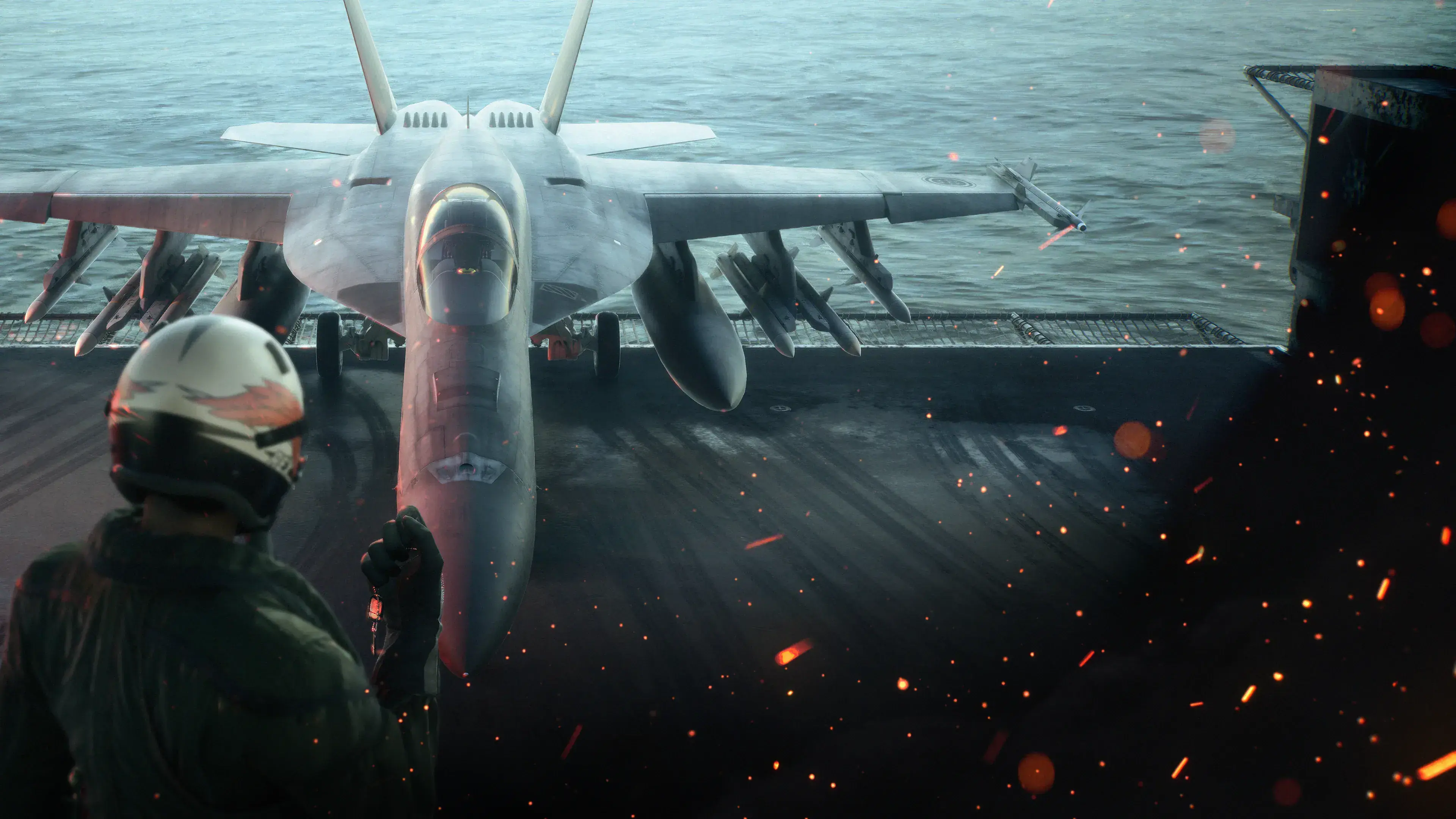
The safest way to use the Ace Combat 8 aircraft tree is to choose one late-game aircraft, trace its required nodes backward, and spend toward that destination. Do not treat every newly available aircraft as a required purchase. Aircraft, special weapons, and upgrade parts all occupy the tree, so the displayed price of a final jet is only part of its real route cost.
For a flexible first campaign, the F-35C route is a strong default: it starts from the free F/A-18C, passes through useful multirole aircraft, adds an Electronic aircraft, and ends at a 550,000-MRP multirole. The F-22A and Su-57 are equally valid destinations if air-to-air combat or personal preference matters more to you. These are route-planning recommendations, not guarantees that one aircraft will solve every mission.
Check the aircraft roster and roles before selecting a destination, then use the MRP budget and farming method to fund its connectors.
Version scope — October 7, 2026: This page was edited from supplied research. No numbered game build or independent playtest is recorded for this guide. Check the current in-game descriptions and your platform before applying build-sensitive conditions.
How the campaign aircraft tree works
MRP is the campaign currency used to buy aircraft, special weapons, and upgrade parts. You earn it from completed campaign and Free Mission sorties. A plane visible on the tree is not necessarily available as a direct purchase: you must own the prerequisite nodes that connect your current position to it.
That distinction matters most with expensive aircraft. Saving the 550,000 MRP printed beside an F-22A, F-35C, or Su-57 is not enough if required aircraft, weapons, or parts remain unpurchased. Before spending, zoom out, select the aircraft you want, and follow every connection back toward a node you already own.
Your campaign purchases remain available in later campaign runs and Free Missions. Campaign progression is separate from ACE COMBAT ONLINE progression, so online aircraft growth does not fill the campaign tree. This makes focused spending more useful than trying to finish the whole tree immediately: the MRP-priced aircraft alone total 8,900,000 MRP, before connecting weapons and parts.
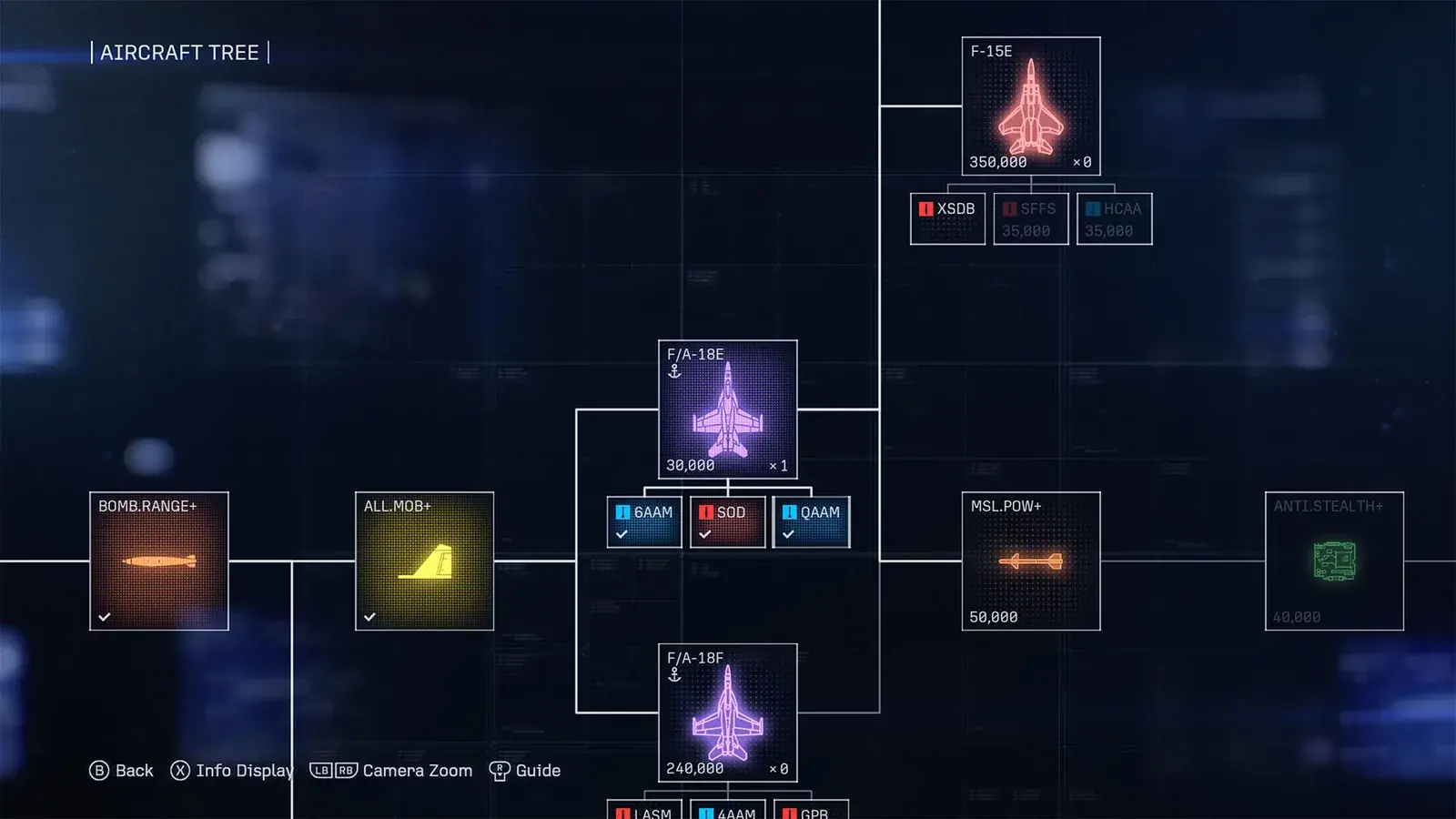
The Aircraft Tree links aircraft purchases with required weapon and upgrade nodes.
Aircraft prices and unlock gates
The table below groups the campaign aircraft by their own purchase price. It does not show cumulative route costs and should not be read as permission to skip connecting nodes.
| Cost or gate | Aircraft |
|---|---|
| Free at the start | F/A-18C Hornet |
| Free after Mission 14 | A-6E Intruder |
| 25,000 MRP | F-4E Phantom II; MiG-21bis Fishbed |
| 90,000 MRP | F-14D Super Tomcat; Su-25SM Frogfoot; EA-6B Prowler |
| 130,000 MRP | Mirage 2000-5; F-2A; MiG-29A Fulcrum; MiG-31B Foxhound |
| 180,000 MRP | Su-33 Flanker-D; Su-47 Berkut; F-16C Fighting Falcon; A-10C Thunderbolt II |
| 240,000 MRP | F/A-18E Super Hornet; F/A-18F Super Hornet; Gripen E; F-15C Eagle; F-15J Eagle; Su-34 Fullback |
| 350,000 MRP | Rafale M; Su-35S Flanker-E; Typhoon; F-15E Strike Eagle; EA-18G Growler |
| 550,000 MRP | F-22A Raptor; F-35C Lightning II; Su-57 Felon |
| 750,000 MRP after Mission 30 | FA-36 Game; EA-36 Barricader |
| 1,000,000 MRP after Mission 30, plus another prerequisite | X-40 Nightmare |
Use this as a budget check, not as a shopping list. A 25,000-MRP aircraft is not cheap in practical terms if it pulls you onto a branch you do not intend to continue. Conversely, a weapon or handling part on your chosen route can be a better immediate purchase than a new airframe because it improves the aircraft you already use.
How to choose your first aircraft-tree route
Start with the mission problem you need to solve and the hangar you actually want. Inspect the briefing, note whether the target mix is primarily aerial, surface-based, or mixed, and check whether the sortie limits aircraft selection. Then choose a late-game destination whose branch gives you useful intermediate options.
A good plan has three layers:
- Destination: Pick one high-end aircraft you genuinely want.
- Route: Trace every required aircraft, weapon, and part back to your current nodes.
- Mission tools: Buy useful equipment on that route when it addresses a current mission, rather than opening unrelated branches.
Choose an aircraft, weapon, or part next
When several adjacent nodes are available, identify what is actually blocking you before spending:
- Buy an aircraft when it is a required route connector, adds carrier compatibility you need, or gives you a role that your current hangar cannot cover comfortably.
- Buy a special weapon when its supported target type addresses a real mission problem and the node remains on your intended route.
- Buy an upgrade part when your existing aircraft already suits the objective and improving it is more useful than replacing it.
- Wait and save when a purchase only opens a side branch that does not support your destination or an immediate mission need.
Weapons and parts are not wasted spending when they are mandatory connectors or improve an aircraft you expect to keep flying. The mistake is treating every side node as equally urgent. Compare the node’s function with the next mission and your planned destination, then buy the smallest useful step.
Avoid calculating only the prices of the aircraft. The connectors are mandatory, but the available information does not provide a complete price map for every connecting weapon and part. Check those values in your own tree before committing MRP. For the F-35C route below, for example, the listed aircraft cost 1,270,000 MRP after the free Hornet, but that is a floor rather than the final route budget.
Flexible route toward the F-35C
The supported aircraft path is F/A-18C Hornet → Mirage 2000-5 → either F/A-18E or F/A-18F Super Hornet → EA-18G Growler → F-35C Lightning II.
| Step | Aircraft price | Why it fits the route |
|---|---|---|
| F/A-18C Hornet | Free | Starting multirole; lets you delay spending while inspecting the tree |
| Mirage 2000-5 | 130,000 MRP | Multirole intermediate aircraft |
| F/A-18E or F/A-18F | 240,000 MRP | Carrier-based multirole choice |
| EA-18G Growler | 350,000 MRP | Electronic option before the destination |
| F-35C Lightning II | 550,000 MRP | High-end carrier-based multirole destination |
Those aircraft purchases total 1,270,000 MRP after the free Hornet. Your actual cost will be higher because connecting weapons and parts must also be purchased. The route is useful because it preserves mixed-target flexibility and includes carrier-capable aircraft, but it is not automatically best for every playstyle.
Fighter routes toward the F-22A or Su-57
Both the F-22A and Su-57 cost 550,000 MRP and are Fighter destinations. Choose one when your priority is air-to-air work or when that aircraft is the hangar goal you care about most. Select it in the tree and verify its current prerequisite line on-screen; do not substitute the F-35C route above, because the current information does not establish identical connectors for all three aircraft.
There is a useful post-campaign reason to choose any of these three high-end jets. Owning the F-22A, F-35C, or Su-57 satisfies the aircraft prerequisite for the X-40 Nightmare after the campaign gate is cleared. That does not make one of them mandatory during the story; it simply lets a first-campaign destination contribute to a later unlock.
Plan around carrier restrictions
Some first-campaign missions restrict you to carrier-capable aircraft. The aircraft tree marks carrier compatibility, so check that icon before buying a land-based plane you expect to use immediately. The F/A-18E, F/A-18F, F-35C, Rafale M, and Su-33 are described in the current information as carrier aircraft, while the route advice also emphasizes the value of naval branches during the opening campaign run.
The practical rule is to keep at least one capable carrier aircraft current with useful weapons and parts. Do not assume a newly purchased aircraft will be selectable in the next mission. Recheck the briefing and sortie screen first, and make sure an expensive land-based purchase will not leave your immediate carrier loadout neglected.
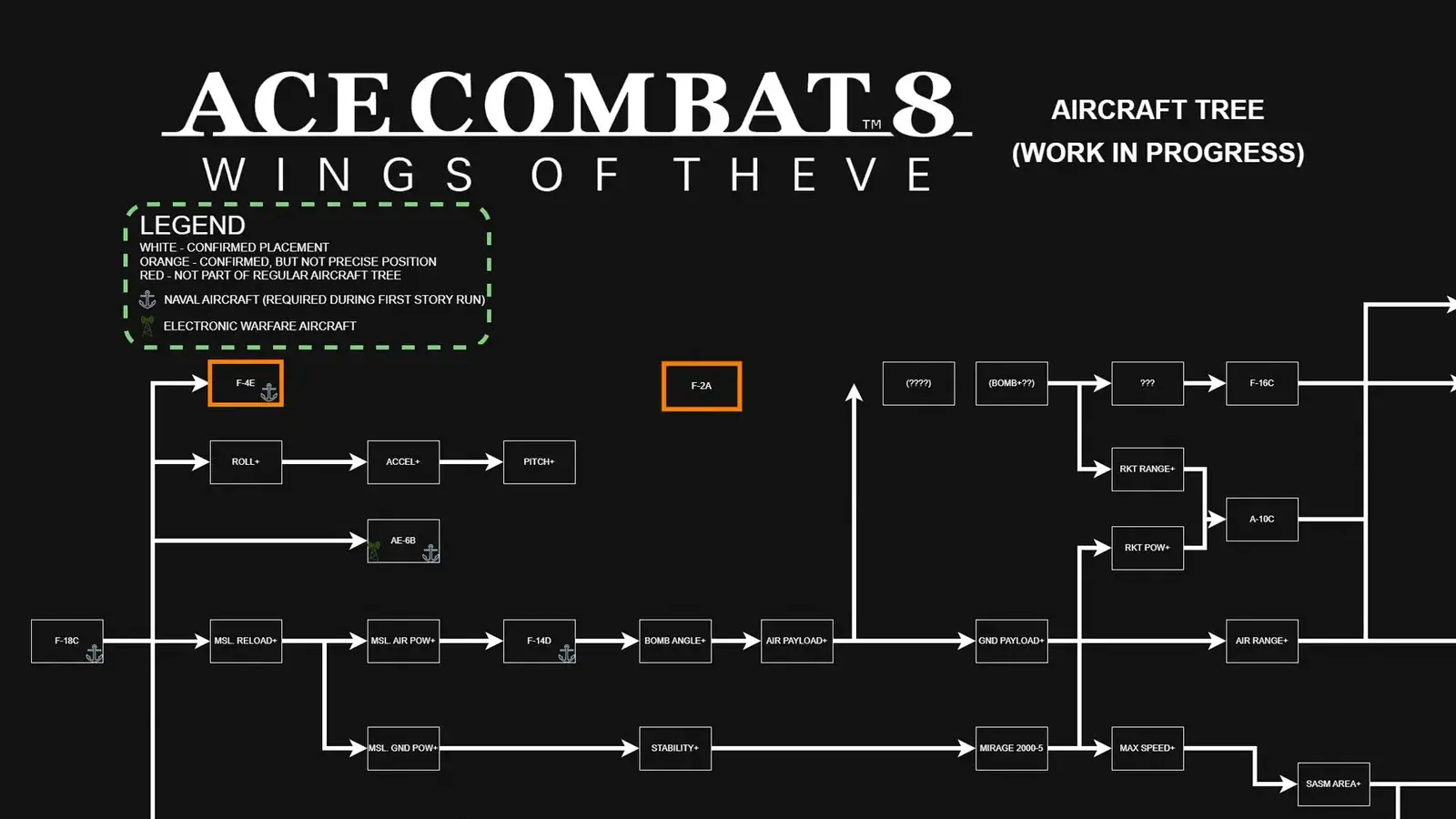
Anchor icons identify carrier-capable aircraft in the tree.
Use roles as guidance, not a power ranking
The tree assigns four roles. They describe a plane’s intended strength, but price and position do not guarantee that it will outperform every earlier aircraft in every mission.
| Role | Best planning use |
|---|---|
| Fighter | Air-to-air interception and dogfighting |
| Attacker | Ground targets, ships, and surface-heavy sorties |
| Multirole | Missions that mix air and surface targets or may change focus |
| Electronic | Jamming and support rather than maximum direct damage |
The free F/A-18C is a useful reason not to rush: as a multirole, it can cover mixed objectives while you study the tree. You also receive the A-6E Intruder after clearing Mission 14, so a dedicated Attacker does not always need to be an early purchase. Buying an A-10C, Su-25SM, or another Attacker can still be sensible when you want that aircraft or need its mission tools; it simply is not an automatic requirement.
Electronic aircraft deserve separate consideration. The EA-6B Prowler is the lower-cost entry at 90,000 MRP, while the EA-18G Growler costs 350,000 MRP and appears on the supported F-35C path. Their value comes from a specialized support role, so judge them by how they fit your squadron and route rather than comparing only direct attack performance.
Post-campaign and bonus aircraft boundaries
Clearing Mission 30, “Song of Wings,” opens the FA-36 Game, EA-36 Barricader, and X-40 Nightmare as campaign-tree purchases. The FA-36 and EA-36 each cost 750,000 MRP. The X-40 costs 1,000,000 MRP and additionally requires ownership of the F-22A, F-35C, or Su-57.
Do not hoard every point through the story solely for these three aircraft. They are post-campaign purchases, so spend enough on a coherent route to keep the campaign manageable. After completion, Free Mission and later campaign runs let you earn more MRP and fill branches you skipped. Which replay is most efficient belongs to a dedicated MRP plan; for the aircraft tree, the important point is that progression continues after the first clear.
The F-14A and ADFX-02 Morgan -PIXY- sit outside normal MRP-tree progression. The F-14A was a preorder bonus. The Morgan is tied to the Season 1 Premium Ace Pass, and campaign use is gated until all campaign missions are complete. Neither should be counted as a normal shortcut through your first-campaign tree.
A practical spending checklist
Before confirming any node, run through this short check:
- Confirm the destination. Know which aircraft the purchase is moving you toward.
- Count connecting nodes. Include required weapons and parts, not only aircraft prices.
- Check the next briefing. Verify target mix and carrier restrictions before buying for an immediate mission.
- Keep one dependable loadout. A useful aircraft with relevant parts and special weapons can be worth more than several unprepared airframes.
- Delay side branches. Return through Free Mission or another campaign run rather than weakening your main route.
- Separate campaign and online progress. MRP-tree purchases do not transfer from ACE COMBAT ONLINE.
- Treat recommendations as options. The F-35C route emphasizes flexibility; the F-22A and Su-57 routes serve different preferences. None guarantees a rank, clear, or ideal result.
If a route becomes uncomfortable, stop widening the tree and inspect the nearest useful nodes on the branch you already funded. The campaign gives you a flexible starting multirole and later a free Attacker, so recovery does not require buying every role at once. A clear destination, verified connectors, and one mission-ready aircraft are enough to keep progressing without wasting MRP.